Important work is managed across spreadsheets
Teams lose time when records are divided across multiple files, duplicated manually or updated without clear ownership.
Custom web application development services
We design and develop responsive web applications for customer-facing services, internal operations, workflow automation, data management and specialised business requirements. Every application is shaped around the people who use it, the information they need and the tasks they must complete—helping your organisation replace disconnected processes with a clearer digital system.
We help businesses replace fragmented tools and repetitive manual tasks with custom web applications designed around defined users, permissions, records and operational workflows.
Teams lose time when records are divided across multiple files, duplicated manually or updated without clear ownership.
Off-the-shelf products may include unnecessary features while still failing to support the organisation’s actual process.
Customers, staff, managers and administrators may require different views, permissions and actions within the same system.
Email chains, chat messages and verbal follow-ups make it difficult to understand the current status of a request or task.
Customer records, documents, payments, notifications and reporting may exist across separate systems with no reliable flow between them.
A fragile codebase, unclear data structure or rigid interface can make every new feature expensive and difficult to maintain.
Complete application delivery
The final scope is shaped around your users, data, permissions, workflows and integrations. The modules below show what a complete custom web-application project can include.
Clarification of the business problem, user groups, existing process, required actions, data, approvals, exceptions and expected outcome.
Planning the application modules, page hierarchy, data relationships, permissions, integrations and technical approach.
Wireframes and responsive interface design for the key tasks each user must complete across desktop, tablet and mobile screens.
Development of the application interface, server-side functionality, database operations, validation and agreed business rules.
Secure sign-in flows and role-based access controls according to the approved user and data-access model.
Integration with agreed third-party services such as payment systems, email platforms, storage, analytics, CRM tools or internal APIs.
Review of key workflows, permissions, forms, data operations, responsive layouts, browsers and agreed functionality.
Production deployment, environment configuration, agreed documentation and the beginning of the support or maintenance arrangement.
Featured application example
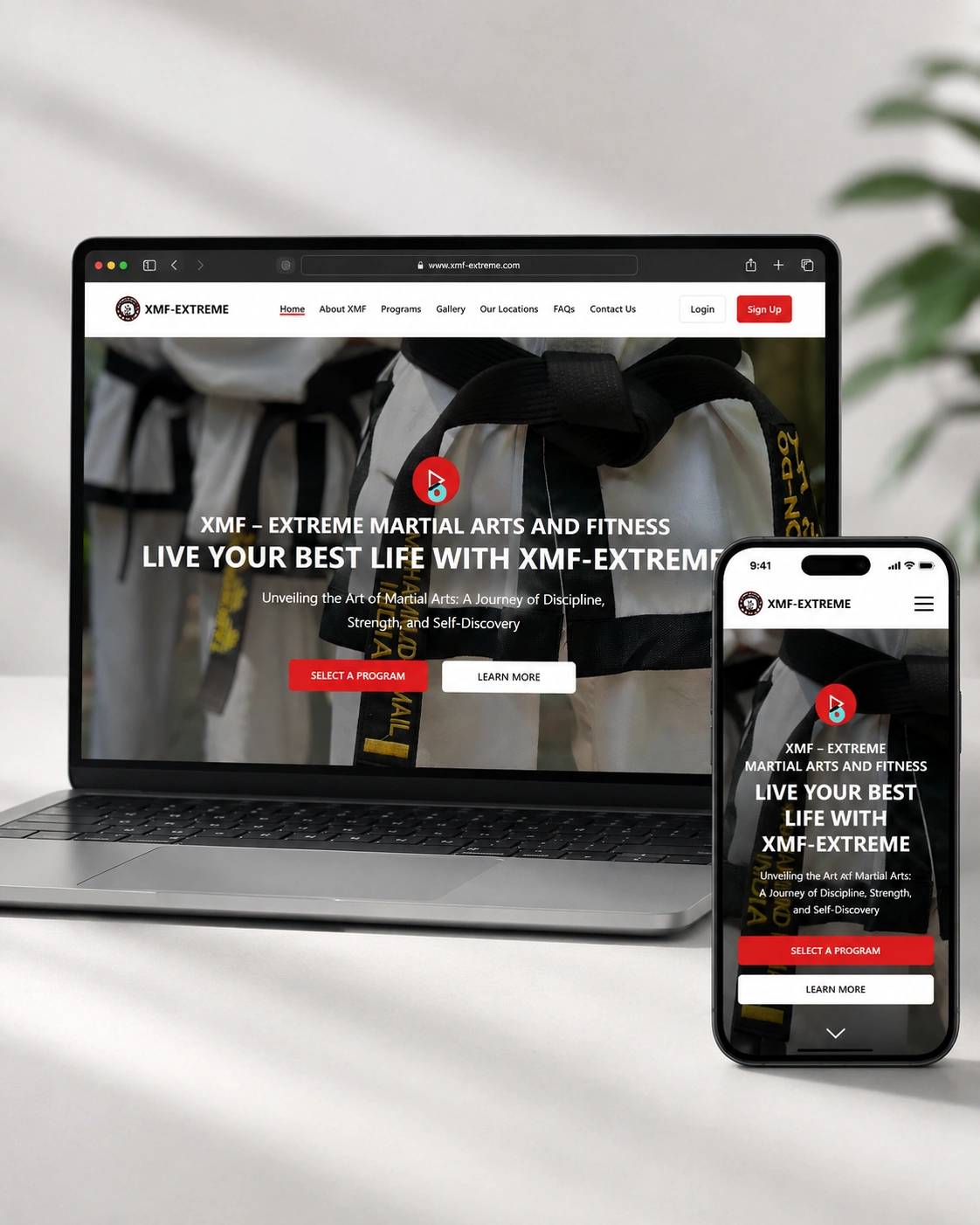
See how we replaced disconnected administrative tools with a unified custom web application for XMF Martial Arts.
XMF Martial Arts
We developed a purpose-built web application with role-based access. Instructors can securely log in to manage attendance, update belt levels, and monitor academy performance, while students gain real-time access to their personalized training statistics and progression history.
Frequently Asked Questions
These answers clarify the scope, frontend and backend development, mobile readiness, systems and project scope before a proposal request.
A custom web application is browser-accessible software developed around a specific set of users, workflows, data and business requirements. Unlike a standard website, it generally allows users to sign in, manage information, complete tasks and interact with application logic.
A business website primarily presents information and supports marketing or enquiries. A web application enables users to perform actions such as managing records, submitting requests, collaborating, processing transactions or completing operational workflows.
Yes. Discovery and workflow planning can be included to clarify the users, modules, permissions, information, integrations and primary business rules before development begins.
Yes. Hyperlink Tech Solutions can manage responsive interface development, backend logic, database operations, authentication, APIs, integrations, testing and deployment according to the agreed scope.
Yes. Role-based access can be implemented for groups such as customers, staff, managers, vendors and administrators. The permissions and accessible data must be clearly defined during planning.
Yes. We can review an existing application for interface improvements, new features, integration work, performance optimisation or technical restructuring. Feasibility depends on the technology, documentation and condition of the current codebase.
Plan your custom application
Share your current process, user groups, required functionality, existing tools and expected timeline. We will review the requirement and recommend a practical discovery or development scope.
Provide a few details about the users, workflow and required functionality, and we will respond with the most suitable next step.